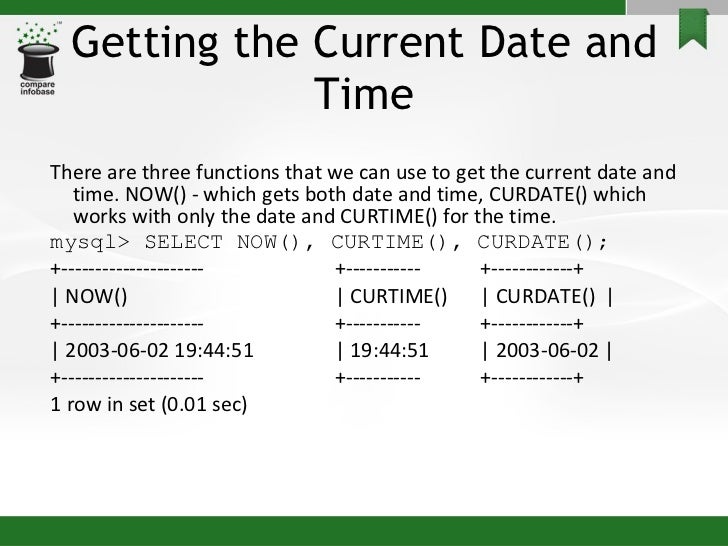
Jun 24, 2013. There are a lot of functions in PHP for dealing with date, time or timestamp. For a Beginner it might be trouble to choose the rights ones, although it's really easy. In this post, I will especially Deal with the situation, where you fetched a Date from MySQL/PostgreSQL table, and you need to display it in a. Name & Description. 1, ADDDATE(). 2, ADDTIME(). 3, CONVERT_TZ(). Converts from one timezone to another. 4, CURDATE(). Returns the current date. 5, CURRENT_DATE(), CURRENT_DATE. Synonyms for CURDATE(). 6, CURRENT_TIME(), CURRENT_TIME. Synonyms for CURTIME().
Not really elegant, but tells you, if your installed timezonedb is the most recent:
<?php
class TestDateTimeTimezonedbVersion extends PHPUnit_Framework_TestCase
{
 public function testTimezonedbIsMostRecent()
 {
ini_set( 'date.timezone', 'Europe/Berlin' );
ob_start();
phpinfo(INFO_MODULES);
$info = ob_get_contents();
ob_end_clean();
$start = strpos( $info, 'Timezone Database Version' ) + 29;
$this->assertTrue( FALSE ! $start, 'Seems there is no timezone DB installed' );
$end = strpos( $info, 'n', $start );
$installedVersion = substr( $info, $start, $end - $start );
exec( 'pecl remote-info timezonedb', &$output );
$availableVersion = substr( $output[2], 12 );
$this->assertEquals( $availableVersion, $installedVersion,
'The installed timezonedb is not actual. Installed: '.$installedVersion
.' available: '.$availableVersion
);
 }
}
?>
This section describes the functions that can be used to manipulate temporal values. See Section 11.3, “Date and Time Types”, for a description of the range of values each date and time type has and the valid formats in which values may be specified.
Table 12.13 Date and Time Functions
| Name | Description |
|---|---|
ADDDATE() | Add time values (intervals) to a date value |
ADDTIME() | Add time |
CONVERT_TZ() | Convert from one time zone to another |
CURDATE() | Return the current date |
CURRENT_DATE(), CURRENT_DATE | Synonyms for CURDATE() |
CURRENT_TIME(), CURRENT_TIME | Synonyms for CURTIME() |
CURRENT_TIMESTAMP(), CURRENT_TIMESTAMP | Synonyms for NOW() |
CURTIME() | Return the current time |
DATE() | Extract the date part of a date or datetime expression |
DATE_ADD() | Add time values (intervals) to a date value |
DATE_FORMAT() | Format date as specified |
DATE_SUB() | Subtract a time value (interval) from a date |
DATEDIFF() | Subtract two dates |
DAY() | Synonym for DAYOFMONTH() |
DAYNAME() | Return the name of the weekday |
DAYOFMONTH() | Return the day of the month (0-31) |
DAYOFWEEK() | Return the weekday index of the argument |
DAYOFYEAR() | Return the day of the year (1-366) |
EXTRACT() | Extract part of a date |
FROM_DAYS() | Convert a day number to a date |
FROM_UNIXTIME() | Format Unix timestamp as a date |
GET_FORMAT() | Return a date format string |
HOUR() | Extract the hour |
LAST_DAY | Return the last day of the month for the argument |
LOCALTIME(), LOCALTIME | Synonym for NOW() |
LOCALTIMESTAMP, LOCALTIMESTAMP() | Synonym for NOW() |
MAKEDATE() | Create a date from the year and day of year |
MAKETIME() | Create time from hour, minute, second |
MICROSECOND() | Return the microseconds from argument |
MINUTE() | Return the minute from the argument |
MONTH() | Return the month from the date passed |
MONTHNAME() | Return the name of the month |
NOW() | Return the current date and time |
PERIOD_ADD() | Add a period to a year-month |
PERIOD_DIFF() | Return the number of months between periods |
QUARTER() | Return the quarter from a date argument |
SEC_TO_TIME() | Converts seconds to 'hh:mm:ss' format |
SECOND() | Return the second (0-59) |
STR_TO_DATE() | Convert a string to a date |
SUBDATE() | Synonym for DATE_SUB() when invoked with three arguments |
SUBTIME() | Subtract times |
SYSDATE() | Return the time at which the function executes |
TIME() | Extract the time portion of the expression passed |
TIME_FORMAT() | Format as time |
TIME_TO_SEC() | Return the argument converted to seconds |
TIMEDIFF() | Subtract time |
TIMESTAMP() | With a single argument, this function returns the date or datetime expression; with two arguments, the sum of the arguments |
TIMESTAMPADD() | Add an interval to a datetime expression |
TIMESTAMPDIFF() | Subtract an interval from a datetime expression |
TO_DAYS() | Return the date argument converted to days |
TO_SECONDS() | Return the date or datetime argument converted to seconds since Year 0 |
UNIX_TIMESTAMP() | Return a Unix timestamp |
UTC_DATE() | Return the current UTC date |
UTC_TIME() | Return the current UTC time |
UTC_TIMESTAMP() | Return the current UTC date and time |
WEEK() | Return the week number |
WEEKDAY() | Return the weekday index |
WEEKOFYEAR() | Return the calendar week of the date (1-53) |
YEAR() | Return the year |
YEARWEEK() | Return the year and week |
Here is an example that uses date functions. The following query selects all rows with a date_col value from within the last 30 days:
The query also selects rows with dates that lie in the future.
Functions that expect date values usually accept datetime values and ignore the time part. Functions that expect time values usually accept datetime values and ignore the date part.
Functions that return the current date or time each are evaluated only once per query at the start of query execution. This means that multiple references to a function such as NOW() within a single query always produce the same result. (For our purposes, a single query also includes a call to a stored program (stored routine, trigger, or event) and all subprograms called by that program.) This principle also applies to CURDATE(), CURTIME(), UTC_DATE(), UTC_TIME(), UTC_TIMESTAMP(), and to any of their synonyms.
The CURRENT_TIMESTAMP(), CURRENT_TIME(), CURRENT_DATE(), and FROM_UNIXTIME() functions return values in the current session time zone, which is available as the session value of the time_zone system variable. In addition, UNIX_TIMESTAMP() assumes that its argument is a datetime value in the session time zone. See Section 5.1.13, “MySQL Server Time Zone Support”.
Some date functions can be used with “zero” dates or incomplete dates such as '2001-11-00', whereas others cannot. Functions that extract parts of dates typically work with incomplete dates and thus can return 0 when you might otherwise expect a nonzero value. For example:
Other functions expect complete dates and return NULL for incomplete dates. These include functions that perform date arithmetic or that map parts of dates to names. For example:
Several functions are more strict when passed a DATE() function value as their argument and reject incomplete dates with a day part of zero. These functions are affected: CONVERT_TZ(), DATE_ADD(), DATE_SUB(), DAYOFYEAR(), LAST_DAY() (permits a day part of zero), TIMESTAMPDIFF(), TO_DAYS(), TO_SECONDS(), WEEK(), WEEKDAY(), WEEKOFYEAR(), YEARWEEK().
Date Functions In Access
Fractional seconds for TIME, DATETIME, and TIMESTAMP values are supported, with up to microsecond precision. Functions that take temporal arguments accept values with fractional seconds. Return values from temporal functions include fractional seconds as appropriate.
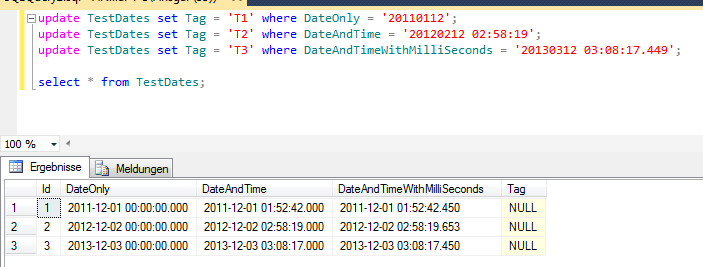
Mysql Get Date
ADDDATE(,date,INTERVALexprunit)ADDDATE(expr,days)When invoked with the
INTERVALform of the second argument,ADDDATE()is a synonym forDATE_ADD(). The related functionSUBDATE()is a synonym forDATE_SUB(). For information on theINTERVALunitargument, see Temporal Intervals.When invoked with the
daysform of the second argument, MySQL treats it as an integer number of days to be added toexpr.ADDTIME()addsexpr2toexpr1and returns the result.expr1is a time or datetime expression, andexpr2is a time expression.CONVERT_TZ()converts a datetime valuedtfrom the time zone given byfrom_tzto the time zone given byto_tzand returns the resulting value. Time zones are specified as described in Section 5.1.13, “MySQL Server Time Zone Support”. This function returnsNULLif the arguments are invalid.If the value falls out of the supported range of the
TIMESTAMPtype when converted fromfrom_tzto UTC, no conversion occurs. TheTIMESTAMPrange is described in Section 11.1.2, “Date and Time Type Overview”.To use named time zones such as
'MET'or'Europe/Amsterdam', the time zone tables must be properly set up. For instructions, see Section 5.1.13, “MySQL Server Time Zone Support”.Returns the current date as a value in
'YYYY-MM-DD'orYYYYMMDDformat, depending on whether the function is used in a string or numeric context.CURRENT_DATE,CURRENT_DATE()CURRENT_DATEandCURRENT_DATE()are synonyms forCURDATE().CURRENT_TIME,CURRENT_TIME([fsp])CURRENT_TIMEandCURRENT_TIME()are synonyms forCURTIME().CURRENT_TIMESTAMP,CURRENT_TIMESTAMP([fsp])CURRENT_TIMESTAMPandCURRENT_TIMESTAMP()are synonyms forNOW().Returns the current time as a value in
'hh:mm:ss'orhhmmssformat, depending on whether the function is used in a string or numeric context. The value is expressed in the session time zone.If the
fspargument is given to specify a fractional seconds precision from 0 to 6, the return value includes a fractional seconds part of that many digits.Extracts the date part of the date or datetime expression
expr.DATEDIFF()returnsexpr1−expr2expressed as a value in days from one date to the other.expr1andexpr2are date or date-and-time expressions. Only the date parts of the values are used in the calculation.DATE_ADD(,date,INTERVALexprunit)DATE_SUB(date,INTERVALexprunit)These functions perform date arithmetic. The
dateargument specifies the starting date or datetime value.expris an expression specifying the interval value to be added or subtracted from the starting date.expris evaluated as a string; it may start with a-for negative intervals.unitis a keyword indicating the units in which the expression should be interpreted.For more information about temporal interval syntax, including a full list of
unitspecifiers, the expected form of theexprargument for eachunitvalue, and rules for operand interpretation in temporal arithmetic, see Temporal Intervals.The return value depends on the arguments:
DATEif thedateargument is aDATEvalue and your calculations involve onlyYEAR,MONTH, andDAYparts (that is, no time parts).DATETIMEif the first argument is aDATETIME(orTIMESTAMP) value, or if the first argument is aDATEand theunitvalue usesHOURS,MINUTES, orSECONDS.String otherwise.
To ensure that the result is
DATETIME, you can useCAST()to convert the first argument toDATETIME.Formats the
datevalue according to theformatstring.The specifiers shown in the following table may be used in the
formatstring. The%character is required before format specifier characters. The specifiers apply to other functions as well:STR_TO_DATE(),TIME_FORMAT(),UNIX_TIMESTAMP().Specifier Description %aAbbreviated weekday name ( Sun..Sat)%bAbbreviated month name ( Jan..Dec)%cMonth, numeric ( 0..12)%DDay of the month with English suffix ( 0th,1st,2nd,3rd, …)%dDay of the month, numeric ( 00..31)%eDay of the month, numeric ( 0..31)%fMicroseconds ( 000000..999999)%HHour ( 00..23)%hHour ( 01..12)%IHour ( 01..12)%iMinutes, numeric ( 00..59)%jDay of year ( 001..366)%kHour ( 0..23)%lHour ( 1..12)%MMonth name ( January..December)%mMonth, numeric ( 00..12)%pAMorPM%rTime, 12-hour ( hh:mm:ssfollowed byAMorPM)%SSeconds ( 00..59)%sSeconds ( 00..59)%TTime, 24-hour ( hh:mm:ss)%UWeek ( 00..53), where Sunday is the first day of the week;WEEK()mode 0%uWeek ( 00..53), where Monday is the first day of the week;WEEK()mode 1%VWeek ( 01..53), where Sunday is the first day of the week;WEEK()mode 2; used with%X%vWeek ( 01..53), where Monday is the first day of the week;WEEK()mode 3; used with%x%WWeekday name ( Sunday..Saturday)%wDay of the week ( 0=Sunday..6=Saturday)%XYear for the week where Sunday is the first day of the week, numeric, four digits; used with %V%xYear for the week, where Monday is the first day of the week, numeric, four digits; used with %v%YYear, numeric, four digits %yYear, numeric (two digits) %%A literal %character%xx, for any “x” not listed aboveRanges for the month and day specifiers begin with zero due to the fact that MySQL permits the storing of incomplete dates such as
'2014-00-00'.The language used for day and month names and abbreviations is controlled by the value of the
lc_time_namessystem variable (Section 10.15, “MySQL Server Locale Support”).For the
%U,%u,%V, and%vspecifiers, see the description of theWEEK()function for information about the mode values. The mode affects how week numbering occurs.DATE_FORMAT()returns a string with a character set and collation given bycharacter_set_connectionandcollation_connectionso that it can return month and weekday names containing non-ASCII characters.See the description for
DATE_ADD().DAY()is a synonym forDAYOFMONTH().Returns the name of the weekday for
date. The language used for the name is controlled by the value of thelc_time_namessystem variable (Section 10.15, “MySQL Server Locale Support”).Returns the day of the month for
date, in the range1to31, or0for dates such as'0000-00-00'or'2008-00-00'that have a zero day part.Returns the weekday index for
date(1= Sunday,2= Monday, …,7= Saturday). These index values correspond to the ODBC standard.Returns the day of the year for
date, in the range1to366.The
EXTRACT()function uses the same kinds ofunitspecifiers asDATE_ADD()orDATE_SUB(), but extracts parts from the date rather than performing date arithmetic. For information on theunitargument, see Temporal Intervals.Given a day number
N, returns aDATEvalue.Use
FROM_DAYS()with caution on old dates. It is not intended for use with values that precede the advent of the Gregorian calendar (1582). See Section 12.8, “What Calendar Is Used By MySQL?”.Returns a representation of the
unix_timestampargument as a value in'YYYY-MM-DD hh:mm:ss'orYYYYMMDDhhmmss.uuuuuuformat, depending on whether the function is used in a string or numeric context.unix_timestampis an internal timestamp value representing seconds since'1970-01-01 00:00:00'UTC, such as produced by theUNIX_TIMESTAMP()function.The return value is expressed in the session time zone. (Clients can set the session time zone as described in Section 5.1.13, “MySQL Server Time Zone Support”.) The
formatstring, if given, is used to format the result the same way as described in the entry for theDATE_FORMAT()function.If you use
UNIX_TIMESTAMP()andFROM_UNIXTIME()to convert between values in a non-UTC time zone and Unix timestamp values, the conversion is lossy because the mapping is not one-to-one in both directions. For details, see the description of theUNIX_TIMESTAMP()function.Returns a format string. This function is useful in combination with the
DATE_FORMAT()and theSTR_TO_DATE()functions.The possible values for the first and second arguments result in several possible format strings (for the specifiers used, see the table in the
DATE_FORMAT()function description). ISO format refers to ISO 9075, not ISO 8601.Function Call Result GET_FORMAT(DATE,'USA')'%m.%d.%Y'GET_FORMAT(DATE,'JIS')'%Y-%m-%d'GET_FORMAT(DATE,'ISO')'%Y-%m-%d'GET_FORMAT(DATE,'EUR')'%d.%m.%Y'GET_FORMAT(DATE,'INTERNAL')'%Y%m%d'GET_FORMAT(DATETIME,'USA')'%Y-%m-%d %H.%i.%s'GET_FORMAT(DATETIME,'JIS')'%Y-%m-%d %H:%i:%s'GET_FORMAT(DATETIME,'ISO')'%Y-%m-%d %H:%i:%s'GET_FORMAT(DATETIME,'EUR')'%Y-%m-%d %H.%i.%s'GET_FORMAT(DATETIME,'INTERNAL')'%Y%m%d%H%i%s'GET_FORMAT(TIME,'USA')'%h:%i:%s %p'GET_FORMAT(TIME,'JIS')'%H:%i:%s'GET_FORMAT(TIME,'ISO')'%H:%i:%s'GET_FORMAT(TIME,'EUR')'%H.%i.%s'GET_FORMAT(TIME,'INTERNAL')'%H%i%s'TIMESTAMPcan also be used as the first argument toGET_FORMAT(), in which case the function returns the same values as forDATETIME.Returns the hour for
time. The range of the return value is0to23for time-of-day values. However, the range ofTIMEvalues actually is much larger, soHOURcan return values greater than23.Takes a date or datetime value and returns the corresponding value for the last day of the month. Returns
NULLif the argument is invalid.LOCALTIME,LOCALTIME([fsp])LOCALTIMEandLOCALTIME()are synonyms forNOW().LOCALTIMESTAMP,LOCALTIMESTAMP([fsp])LOCALTIMESTAMPandLOCALTIMESTAMP()are synonyms forNOW().Returns a date, given year and day-of-year values.
dayofyearmust be greater than 0 or the result isNULL.Returns a time value calculated from the
hour,minute, andsecondarguments.The
secondargument can have a fractional part.Returns the microseconds from the time or datetime expression
expras a number in the range from0to999999.Returns the minute for
time, in the range0to59.Returns the month for
date, in the range1to12for January to December, or0for dates such as'0000-00-00'or'2008-00-00'that have a zero month part.Returns the full name of the month for
date. The language used for the name is controlled by the value of thelc_time_namessystem variable (Section 10.15, “MySQL Server Locale Support”).Returns the current date and time as a value in
'YYYY-MM-DD hh:mm:ss'orYYYYMMDDhhmmssformat, depending on whether the function is used in a string or numeric context. The value is expressed in the session time zone.If the
fspargument is given to specify a fractional seconds precision from 0 to 6, the return value includes a fractional seconds part of that many digits.NOW()returns a constant time that indicates the time at which the statement began to execute. (Within a stored function or trigger,NOW()returns the time at which the function or triggering statement began to execute.) This differs from the behavior forSYSDATE(), which returns the exact time at which it executes.In addition, the
SET TIMESTAMPstatement affects the value returned byNOW()but not bySYSDATE(). This means that timestamp settings in the binary log have no effect on invocations ofSYSDATE(). Setting the timestamp to a nonzero value causes each subsequent invocation ofNOW()to return that value. Setting the timestamp to zero cancels this effect so thatNOW()once again returns the current date and time.See the description for
SYSDATE()for additional information about the differences between the two functions.Adds
Nmonths to periodP(in the formatYYMMorYYYYMM). Returns a value in the formatYYYYMM.The period argument
Pis not a date value.Returns the number of months between periods
P1andP2.P1andP2should be in the formatYYMMorYYYYMM. Note that the period argumentsP1andP2are not date values.Returns the quarter of the year for
date, in the range1to4.Returns the second for
time, in the range0to59.Returns the
secondsargument, converted to hours, minutes, and seconds, as aTIMEvalue. The range of the result is constrained to that of theTIMEdata type. A warning occurs if the argument corresponds to a value outside that range.This is the inverse of the
DATE_FORMAT()function. It takes a stringstrand a format stringformat.STR_TO_DATE()returns aDATETIMEvalue if the format string contains both date and time parts, or aDATEorTIMEvalue if the string contains only date or time parts. If the date, time, or datetime value extracted fromstris illegal,STR_TO_DATE()returnsNULLand produces a warning.The server scans
strattempting to matchformatto it. The format string can contain literal characters and format specifiers beginning with%. Literal characters informatmust match literally instr. Format specifiers informatmust match a date or time part instr. For the specifiers that can be used informat, see theDATE_FORMAT()function description.Scanning starts at the beginning of
strand fails ifformatis found not to match. Extra characters at the end ofstrare ignored.Unspecified date or time parts have a value of 0, so incompletely specified values in
strproduce a result with some or all parts set to 0:Range checking on the parts of date values is as described in Section 11.3.1, “The DATE, DATETIME, and TIMESTAMP Types”. This means, for example, that “zero” dates or dates with part values of 0 are permitted unless the SQL mode is set to disallow such values.
If the
NO_ZERO_DATEorNO_ZERO_IN_DATESQL mode is enabled, zero dates or part of dates are disallowed. In that case,STR_TO_DATE()returnsNULLand generates a warning:You cannot use format
'%X%V'to convert a year-week string to a date because the combination of a year and week does not uniquely identify a year and month if the week crosses a month boundary. To convert a year-week to a date, you should also specify the weekday:SUBDATE(,date,INTERVALexprunit)SUBDATE(expr,days)When invoked with the
INTERVALform of the second argument,SUBDATE()is a synonym forDATE_SUB(). For information on theINTERVALunitargument, see the discussion forDATE_ADD().The second form enables the use of an integer value for
days. In such cases, it is interpreted as the number of days to be subtracted from the date or datetime expressionexpr.SUBTIME()returnsexpr1−expr2expressed as a value in the same format asexpr1.expr1is a time or datetime expression, andexpr2is a time expression.Returns the current date and time as a value in
'YYYY-MM-DD hh:mm:ss'orYYYYMMDDhhmmssformat, depending on whether the function is used in a string or numeric context.If the
fspargument is given to specify a fractional seconds precision from 0 to 6, the return value includes a fractional seconds part of that many digits.SYSDATE()returns the time at which it executes. This differs from the behavior forNOW(), which returns a constant time that indicates the time at which the statement began to execute. (Within a stored function or trigger,NOW()returns the time at which the function or triggering statement began to execute.)In addition, the
SET TIMESTAMPstatement affects the value returned byNOW()but not bySYSDATE(). This means that timestamp settings in the binary log have no effect on invocations ofSYSDATE().Because
SYSDATE()can return different values even within the same statement, and is not affected bySET TIMESTAMP, it is nondeterministic and therefore unsafe for replication if statement-based binary logging is used. If that is a problem, you can use row-based logging.Alternatively, you can use the
--sysdate-is-nowoption to causeSYSDATE()to be an alias forNOW(). This works if the option is used on both the master and the slave.The nondeterministic nature of
SYSDATE()also means that indexes cannot be used for evaluating expressions that refer to it.Extracts the time part of the time or datetime expression
exprand returns it as a string.This function is unsafe for statement-based replication. A warning is logged if you use this function when
binlog_formatis set toSTATEMENT.TIMEDIFF()returnsexpr1−expr2expressed as a time value.expr1andexpr2are time or date-and-time expressions, but both must be of the same type.The result returned by
TIMEDIFF()is limited to the range allowed forTIMEvalues. Alternatively, you can use either of the functionsTIMESTAMPDIFF()andUNIX_TIMESTAMP(), both of which return integers.TIMESTAMP(,expr)TIMESTAMP(expr1,expr2)With a single argument, this function returns the date or datetime expression
expras a datetime value. With two arguments, it adds the time expressionexpr2to the date or datetime expressionexpr1and returns the result as a datetime value.Adds the integer expression
intervalto the date or datetime expressiondatetime_expr. The unit forintervalis given by theunitargument, which should be one of the following values:MICROSECOND(microseconds),SECOND,MINUTE,HOUR,DAY,WEEK,MONTH,QUARTER, orYEAR.The
unitvalue may be specified using one of keywords as shown, or with a prefix ofSQL_TSI_. For example,DAYandSQL_TSI_DAYboth are legal.Returns
datetime_expr2−datetime_expr1, wheredatetime_expr1anddatetime_expr2are date or datetime expressions. One expression may be a date and the other a datetime; a date value is treated as a datetime having the time part'00:00:00'where necessary. The unit for the result (an integer) is given by theunitargument. The legal values forunitare the same as those listed in the description of theTIMESTAMPADD()function.The order of the date or datetime arguments for this function is the opposite of that used with the
TIMESTAMP()function when invoked with 2 arguments.This is used like the
DATE_FORMAT()function, but theformatstring may contain format specifiers only for hours, minutes, seconds, and microseconds. Other specifiers produce aNULLvalue or0.If the
timevalue contains an hour part that is greater than23, the%Hand%khour format specifiers produce a value larger than the usual range of0..23. The other hour format specifiers produce the hour value modulo 12.Returns the
timeargument, converted to seconds.Given a date
date, returns a day number (the number of days since year 0).TO_DAYS()is not intended for use with values that precede the advent of the Gregorian calendar (1582), because it does not take into account the days that were lost when the calendar was changed. For dates before 1582 (and possibly a later year in other locales), results from this function are not reliable. See Section 12.8, “What Calendar Is Used By MySQL?”, for details.Remember that MySQL converts two-digit year values in dates to four-digit form using the rules in Section 11.3, “Date and Time Types”. For example,
'2008-10-07'and'08-10-07'are seen as identical dates:In MySQL, the zero date is defined as
'0000-00-00', even though this date is itself considered invalid. This means that, for'0000-00-00'and'0000-01-01',TO_DAYS()returns the values shown here:This is true whether or not the
ALLOW_INVALID_DATESSQL server mode is enabled.Given a date or datetime
expr, returns the number of seconds since the year 0. Ifexpris not a valid date or datetime value, returnsNULL.Like
TO_DAYS(),TO_SECONDS()is not intended for use with values that precede the advent of the Gregorian calendar (1582), because it does not take into account the days that were lost when the calendar was changed. For dates before 1582 (and possibly a later year in other locales), results from this function are not reliable. See Section 12.8, “What Calendar Is Used By MySQL?”, for details.Like
TO_DAYS(),TO_SECONDS(), converts two-digit year values in dates to four-digit form using the rules in Section 11.3, “Date and Time Types”.In MySQL, the zero date is defined as
'0000-00-00', even though this date is itself considered invalid. This means that, for'0000-00-00'and'0000-01-01',TO_SECONDS()returns the values shown here:This is true whether or not the
ALLOW_INVALID_DATESSQL server mode is enabled.If
UNIX_TIMESTAMP()is called with nodateargument, it returns a Unix timestamp representing seconds since'1970-01-01 00:00:00'UTC.If
UNIX_TIMESTAMP()is called with adateargument, it returns the value of the argument as seconds since'1970-01-01 00:00:00'UTC. The server interpretsdateas a value in the session time zone and converts it to an internal Unix timestamp value in UTC. (Clients can set the session time zone as described in Section 5.1.13, “MySQL Server Time Zone Support”.) Thedateargument may be aDATE,DATETIME, orTIMESTAMPstring, or a number inYYMMDD,YYMMDDhhmmss,YYYYMMDD, orYYYYMMDDhhmmssformat. If the argument includes a time part, it may optionally include a fractional seconds part.The return value is an integer if no argument is given or the argument does not include a fractional seconds part, or
DECIMALif an argument is given that includes a fractional seconds part.When the
dateargument is aTIMESTAMPcolumn,UNIX_TIMESTAMP()returns the internal timestamp value directly, with no implicit “string-to-Unix-timestamp” conversion.The valid range of argument values is the same as for the
TIMESTAMPdata type:'1970-01-01 00:00:01.000000'UTC to'2038-01-19 03:14:07.999999'UTC. If you pass an out-of-range date toUNIX_TIMESTAMP(), it returns0.If you use
UNIX_TIMESTAMP()andFROM_UNIXTIME()to convert between values in a non-UTC time zone and Unix timestamp values, the conversion is lossy because the mapping is not one-to-one in both directions. For example, due to conventions for local time zone changes such as Daylight Saving Time (DST), it is possible forUNIX_TIMESTAMP()to map two values that are distinct in a non-UTC time zone to the same Unix timestamp value.FROM_UNIXTIME()will map that value back to only one of the original values. Here is an example, using values that are distinct in theMETtime zone:To use named time zones such as
'MET'or'Europe/Amsterdam', the time zone tables must be properly set up. For instructions, see Section 5.1.13, “MySQL Server Time Zone Support”.If you want to subtract
UNIX_TIMESTAMP()columns, you might want to cast them to signed integers. See Section 12.10, “Cast Functions and Operators”.UTC_DATE,UTC_DATE()Returns the current UTC date as a value in
'YYYY-MM-DD'orYYYYMMDDformat, depending on whether the function is used in a string or numeric context.UTC_TIME,UTC_TIME([fsp])Returns the current UTC time as a value in
'hh:mm:ss'orhhmmssformat, depending on whether the function is used in a string or numeric context.If the
fspargument is given to specify a fractional seconds precision from 0 to 6, the return value includes a fractional seconds part of that many digits.UTC_TIMESTAMP,UTC_TIMESTAMP([fsp])Returns the current UTC date and time as a value in
'YYYY-MM-DD hh:mm:ss'orYYYYMMDDhhmmssformat, depending on whether the function is used in a string or numeric context.If the
fspargument is given to specify a fractional seconds precision from 0 to 6, the return value includes a fractional seconds part of that many digits.This function returns the week number for
date. The two-argument form ofWEEK()enables you to specify whether the week starts on Sunday or Monday and whether the return value should be in the range from0to53or from1to53. If themodeargument is omitted, the value of thedefault_week_formatsystem variable is used. See Section 5.1.8, “Server System Variables”.The following table describes how the
modeargument works.Mode First day of week Range Week 1 is the first week … 0 Sunday 0-53 with a Sunday in this year 1 Monday 0-53 with 4 or more days this year 2 Sunday 1-53 with a Sunday in this year 3 Monday 1-53 with 4 or more days this year 4 Sunday 0-53 with 4 or more days this year 5 Monday 0-53 with a Monday in this year 6 Sunday 1-53 with 4 or more days this year 7 Monday 1-53 with a Monday in this year For
modevalues with a meaning of “with 4 or more days this year,” weeks are numbered according to ISO 8601:1988:If the week containing January 1 has 4 or more days in the new year, it is week 1.
Otherwise, it is the last week of the previous year, and the next week is week 1.
If a date falls in the last week of the previous year, MySQL returns
0if you do not use2,3,6, or7as the optionalmodeargument:One might argue that
WEEK()should return52because the given date actually occurs in the 52nd week of 1999.WEEK()returns0instead so that the return value is “the week number in the given year.” This makes use of theWEEK()function reliable when combined with other functions that extract a date part from a date.If you prefer a result evaluated with respect to the year that contains the first day of the week for the given date, use
0,2,5, or7as the optionalmodeargument.Alternatively, use the
YEARWEEK()function:Returns the weekday index for
date(0= Monday,1= Tuesday, …6= Sunday).Returns the calendar week of the date as a number in the range from
1to53.WEEKOFYEAR()is a compatibility function that is equivalent toWEEK(.date,3)Returns the year for
date, in the range1000to9999, or0for the “zero” date.YEARWEEK(,date)YEARWEEK(date,mode)Returns year and week for a date. The year in the result may be different from the year in the date argument for the first and the last week of the year.
The
modeargument works exactly like themodeargument toWEEK(). For the single-argument syntax, amodevalue of 0 is used. UnlikeWEEK(), the value ofdefault_week_formatdoes not influenceYEARWEEK().The week number is different from what the
WEEK()function would return (0) for optional arguments0or1, asWEEK()then returns the week in the context of the given year.
Top Posts
- Medical Staffing Business Manual Example
- Biomechanics Of The Musculoskeletal System Nigg Pdf To Word
- Edge Blending Software Free Download
- Bronica Lens Serial Numbers
- Heartless Hindi Movie Free Torrent Download
- Pocket Tanks Deluxe Game Free Download Full Version For Windows 7
- Minitab 17 Product Key Keygen Software
- Asus Eee Pc Recovery Disk Download Xp
- Chain Of Strength One Thing That Still Holds True Rar
- The Supreme Philosophy Of Man The Laws Of Life Pdf Files
- Undercover Brother Ita Download Dvdrip Torrents
- Subtitrari Merlin 1998 Full